Introduction
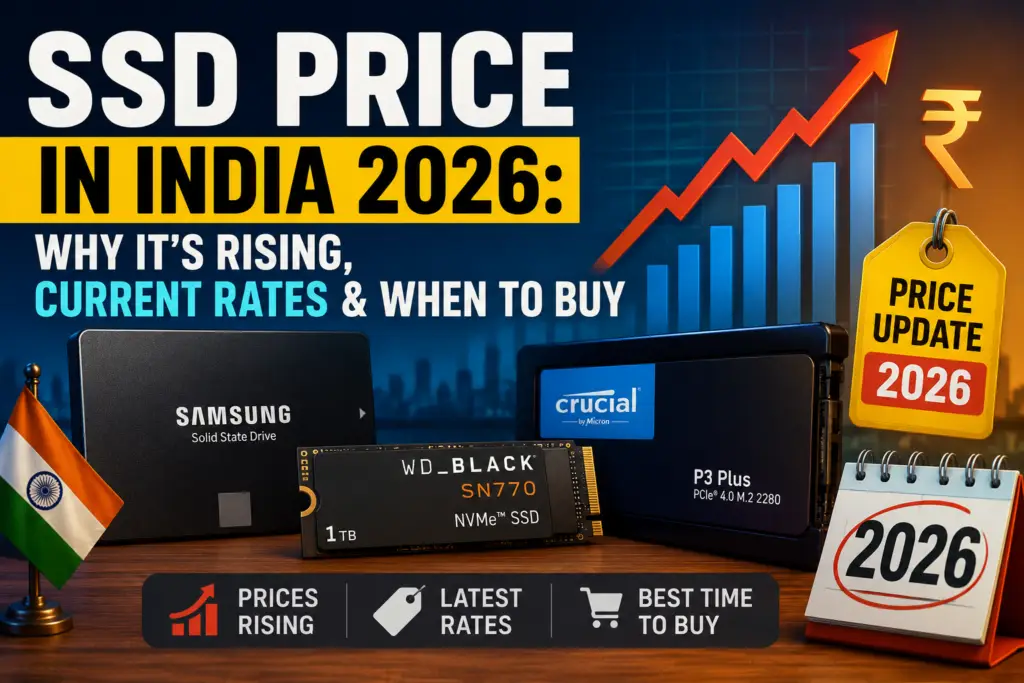
If you’ve priced an SSD in India recently and done a double-take — you’re not imagining it. A 512GB SSD that cost ₹2,800–₹3,200 in late 2024 is now listing anywhere between ₹3,800 and ₹4,800 on Amazon and Flipkart. Some brands have crossed ₹5,000 for a unit that felt like a budget buy just 18 months ago.
This article breaks down what’s actually driving SSD prices up in India in 2026, what you should expect to pay right now for 512GB, 1TB, and 2TB drives, and — most practically — whether you should buy now or wait.
No filler. No “prices may vary.” Just the clearest picture of India’s SSD market we can give you with data.
⚡ Quick Answer
Why are SSD prices rising in India in 2026? Three overlapping reasons: NAND flash supply tightened after major fabs cut capacity in 2023–24, US tariffs on Chinese electronics components cascaded through the supply chain, and the Indian rupee’s weakness against the dollar made imports more expensive. Prices rose 30–50% between mid-2024 and mid-2026 depending on the brand and form factor.
Current benchmark prices (June 2026):
- 512GB SATA SSD: ₹3,800–₹5,200
- 512GB NVMe M.2: ₹4,200–₹6,000
- 1TB SATA SSD: ₹6,500–₹8,500
- 1TB NVMe M.2: ₹7,000–₹10,500
- 2TB NVMe M.2: ₹13,000–₹18,000
Should you buy now or wait? Buy now if you need storage immediately. Prices are unlikely to drop significantly before Q4 2026 at the earliest, and analysts project mild recovery into 2027, not a crash.
Why SSD Prices Are Rising in India: The Full Picture
1. The NAND Flash Supply Crunch (The Root Cause)
SSDs are built on NAND flash memory. Three companies — Samsung, SK Hynix, and Micron — control roughly 70% of global NAND supply. In 2022–2023, there was a severe NAND glut. Prices collapsed. Manufacturers responded by deliberately reducing production capacity.
That supply cut was supposed to balance the market. Instead, demand recovered faster than expected — driven by AI server buildouts (which consume enormous amounts of NAND for training data storage), laptop refresh cycles post-pandemic, and enterprise SSD demand. Production lines can’t be instantly switched back on. The result: less supply, more demand, higher prices. This dynamic started pushing prices up in H2 2024 and accelerated through 2025–2026.
2. US Tariffs and the China Supply Chain Knock-On
The US imposed additional tariffs on Chinese electronics components starting in 2025. While India is not the US, this matters because a significant portion of the SSDs sold in India — especially budget brands like Kingston, Crucial, and a dozen white-label brands on Amazon — source components from Chinese manufacturers who also supply the US market.
When those manufacturers face higher US export costs, they pass costs across all markets. Indian distributors and importers absorbed some of this, but not all of it. A portion landed on the retail price.
3. Rupee Depreciation
The dollar-to-rupee exchange rate is a quiet but consistent pressure on all imported electronics in India. In 2023, a dollar cost roughly ₹82–83. Through 2025 into 2026, it has sat in the ₹85–88 range for extended periods, with spikes toward ₹90 during periods of dollar strength.
Since SSDs are priced globally in USD and imported into India, every rupee of depreciation adds to the landed cost. A 5–7% currency shift on a ₹4,000 product is ₹200–₹280 per unit — which shows up in retail prices.
4. Why Budget Brands Got Hit Harder
Premium brands like Samsung, WD Black, and Seagate have more pricing power and supply chain leverage. Budget brands — the ones most price-sensitive Indian buyers shop — tend to use spot market NAND rather than long-term supply contracts. Spot prices are more volatile. When NAND got expensive, budget SSD makers had to raise prices faster and by larger margins than Samsung or Crucial.
This is why the 2026 price hike feels especially sharp to the typical Indian buyer: the ₹2,500–₹3,500 segment that once offered excellent value has essentially evaporated.
Current SSD Prices in India (June 2026)
These are representative retail prices from major platforms as of the time of writing. Prices fluctuate — check current listings before buying.
512GB SSDs
| Drive | Type | Approx. Price (₹) | Speed (Read/Write) |
|---|---|---|---|
| Samsung 870 EVO | SATA | 4,800–5,200 | 560/530 MB/s |
| WD Blue SA510 | SATA | 4,200–4,800 | 560/520 MB/s |
| Kingston A400 | SATA | 3,800–4,200 | 500/450 MB/s |
| Samsung 980 | NVMe M.2 | 5,200–6,000 | 3,500/3,000 MB/s |
| WD Blue SN580 | NVMe M.2 | 4,800–5,500 | 4,150/4,150 MB/s |
| Crucial P3 | NVMe M.2 | 4,200–5,000 | 3,500/3,000 MB/s |
1TB SSDs
| Drive | Type | Approx. Price (₹) | Speed (Read/Write) |
|---|---|---|---|
| Samsung 870 EVO | SATA | 7,500–8,500 | 560/530 MB/s |
| WD Blue SA510 | SATA | 6,500–7,500 | 560/520 MB/s |
| Samsung 980 Pro | NVMe M.2 | 9,000–10,500 | 7,000/5,000 MB/s |
| WD Black SN850X | NVMe M.2 | 10,000–12,000 | 7,300/6,600 MB/s |
| Crucial P3 Plus | NVMe M.2 | 7,000–8,500 | 5,000/4,200 MB/s |
Price Per GB Benchmark (2026 vs Historical)
- 2022 (price crash era): ~₹5–6 per GB
- 2024 (post-recovery): ~₹6–7 per GB
- 2026 (current): ~₹8–10 per GB for quality drives, ₹7–8 for budget options
The price per GB metric matters because it tells you whether a 1TB deal is actually better value than 512GB — and right now, 1TB drives offer slightly better per-GB value than 512GB in most categories.
Latest Updates for 2026
What changed in early 2026:
- Samsung announced a capacity expansion at its NAND fabs in Q1 2026, but new supply from those expansions won’t hit the market until late 2026 at earliest.
- QLC NAND (used in budget SSDs) remains significantly tighter than TLC, which is why the cheapest drives have seen the largest price jumps.
- A few brands — notably Lexar and Addlink — have quietly exited active distribution in India as margins compressed, reducing competition in the mid-range.
- PS5-compatible NVMe SSDs (M.2 2280, PCIe 4.0 with heatsink) saw a separate price spike following PS5 adoption growth in India; expect to pay a 20–30% premium over an equivalent laptop SSD.
Import duty clarification (2026): The 15% basic customs duty on SSDs that India introduced in 2023 remains in effect. Importers initially absorbed part of this; in 2025–2026, that absorption has largely ended and the full duty impact is visible in retail pricing.
SSD Buying Guide: Which Capacity Should You Buy in India Right Now?
If Your Budget Is Under ₹5,000
The honest answer: the 512GB market is your only realistic option at this price. Don’t chase a 1TB deal under ₹5,000 — legitimate 1TB drives aren’t available there in 2026. If you see one, it’s either a counterfeit, a very slow QLC drive, or a clearance deal worth scrutinizing carefully.
Best pick under ₹5,000: Kingston NV3 1TB NVMe (occasionally available at ₹4,800–5,200 on sale) or Crucial P3 512GB.
If Your Budget Is ₹5,000–₹8,000
This is where the 1TB NVMe category starts becoming accessible. At this range, you can get a Crucial P3 1TB or WD Blue SN580 1TB — both solid choices for laptop upgrades, desktop builds, and PS5 storage expansion.
For pure SATA needs (older laptops, desktop secondary drives), Samsung 870 EVO 1TB is the gold standard. It costs more but lasts longer than budget alternatives.
If Your Budget Is ₹8,000+
Go NVMe, go 1TB or 2TB, and prioritize TLC over QLC. At this budget, the WD Black SN850X and Samsung 990 Pro start making sense, especially for gaming or video editing workloads where sustained write performance matters.
Will SSD Prices Drop? When to Buy
This is the question most people searching these topics actually want answered, so here is a direct take:
Prices are unlikely to drop meaningfully before Q4 2026. The NAND supply expansion Samsung and SK Hynix announced won’t clear distributors and reach Indian retail shelves for at least 6–9 months from their production dates. Indian importers also tend to hold inventory purchased at higher prices before adjusting retail.
The scenarios where prices drop sooner:
- A major demand slowdown (recession, consumer spending contraction)
- Aggressive pricing competition from Chinese brands re-entering the Indian market
- A rupee strengthening against the dollar above ₹83–84 territory
The scenarios where prices stay elevated or rise further:
- US-China tech trade tensions escalating further
- AI infrastructure demand remaining at current levels, consuming NAND supply
- Seasonal buying spike during college admissions and festive season (August–November)
Practical advice: If you need a drive today, buy it. If your existing storage is functional for another 6–12 months, waiting until January–March 2027 is the more price-efficient strategy based on current supply projections.
Step-by-Step: How to Buy an SSD in India Without Getting Ripped Off
Step 1: Identify your form factor before anything else Check whether you need a 2.5″ SATA (older laptops, desktops), M.2 SATA, or M.2 NVMe (PCIe 3.0 or 4.0). A wrong form factor is a return, not an upgrade. Most laptops made after 2020 support M.2 NVMe.
Step 2: Check your PCIe generation If your laptop or PC supports PCIe 4.0, don’t buy a PCIe 3.0 NVMe. You paid for speed headroom — use it. If you only have PCIe 3.0, a PCIe 4.0 drive works but gives you no speed advantage.
Step 3: Decide capacity based on use case, not just price
- Content creator / video editor: 1TB minimum, 2TB if your budget allows
- Everyday use / student: 512GB is enough if you offload media
- Gaming PC: 1TB minimum; AAA games now routinely exceed 80–100GB each
- Secondary / backup drive: 1TB or 2TB SATA is cost-effective here
Step 4: Cross-check price on Amazon and Flipkart on the same day SSD prices change frequently. The same Crucial 1TB NVMe can be ₹700–1,000 different between platforms on the same day. Check both before buying.
Step 5: Verify the seller Buy only from Fulfilled by Amazon or Flipkart Assured listings, or from the brand’s official store. Third-party marketplace sellers on SSDs have a documented history of selling refurbished, re-sealed, or counterfeit units. The price difference is rarely worth the risk.
Step 6: Check the warranty terms Samsung and WD offer 5-year warranties on their mid-to-premium drives in India. Budget brands typically offer 3 years, and some offer only 1–2 years. A ₹500 saving on an SSD with half the warranty isn’t a saving.
Common Problems and Solutions
Problem: “The SSD I just bought shows less capacity than advertised” This is normal. A “512GB” SSD has approximately 476GiB of usable space as shown by Windows/macOS, because drive manufacturers use decimal (1GB = 1,000,000,000 bytes) while operating systems use binary (1GiB = 1,073,741,824 bytes). There’s nothing wrong with the drive.
Problem: “My new SSD is slower than my old HDD in large file transfers” This happens with QLC drives when their SLC cache fills. Budget QLC NVMe drives can drop to HDD-level speeds (~100–150 MB/s) on sustained large writes after their cache (typically 8–15GB) is exhausted. This is a hardware limitation, not a defect. Solution: either avoid budget QLC for write-heavy use, or don’t buy the cheapest possible drive.
Problem: “SSD not detected after installation” First check: is the M.2 screw tight? Loose M.2 slots are the number-one cause of “not detected” issues. Second check: did your BIOS update and reset to “RAID” mode instead of “AHCI”? For most consumer SSDs, AHCI mode is required.
Problem: “Should I clone my old HDD or do a fresh install?” Fresh install is always better if time allows. Cloning carries over fragmented data, old drivers, and potentially bloatware. If you’re upgrading from HDD to SSD, a fresh Windows install will visibly outperform a clone of the same system.
Problem: “I bought an SSD and it’s getting very hot” M.2 NVMe drives, especially PCIe 4.0 models, generate significant heat. If your laptop or PC doesn’t have a heatsink on the M.2 slot, throttling is possible under heavy load. Most mid-range M.2 NVMe drives come with a heatsink now — keep it on. If your laptop case makes installation difficult without removing it, at minimum apply a thermal pad.
Frequently Asked Questions
Q1: What is the current price of a 512GB SSD in India in 2026? A 512GB SATA SSD currently costs between ₹3,800–₹5,200 from reputable brands. NVMe 512GB drives range from ₹4,200–₹6,000. Prices vary by brand, seller, and platform sales.
Q2: Why did SSD prices increase in India in 2025 and 2026? The primary causes are a tightening of global NAND flash supply (manufacturers cut production in 2023 and demand recovered faster than supply), US tariffs on Chinese electronics components flowing through to India’s import ecosystem, and rupee depreciation against the dollar making all imported storage more expensive.
Q3: Is 512GB SSD enough in 2026? For everyday use, students, and general office/productivity work — yes. If you use your system for gaming (modern games regularly exceed 80GB each), video editing, or content creation, 1TB is a better baseline. A 512GB drive will feel cramped faster than you expect if you have a large media library.
Q4: Should I buy a SATA SSD or NVMe SSD in India right now? NVMe, unless your system doesn’t support it. For the same capacity, the price difference between mid-range SATA and entry NVMe has narrowed significantly in 2026. NVMe is 3–6x faster on sequential reads/writes and will serve you better across the 3–5 year lifespan of the drive.
Q5: Which 1TB SSD is best value in India in 2026? For most buyers, the WD Blue SN580 1TB (NVMe, PCIe 4.0) offers the best balance of performance, reliability, and price at the ₹7,000–₹8,500 range. The Crucial P3 1TB is a reasonable budget alternative but uses QLC NAND — fine for general use, not ideal for heavy sustained writes.
Q6: Are cheap Chinese SSDs (Lexar, Addlink, etc.) safe to buy? Brands like Lexar and Crucial (both now owned by Micron parent-related entities) are generally fine. Genuinely no-name drives from Amazon marketplace sellers with no recognizable brand are risky — NAND quality is unverifiable and warranty support is often nonexistent. Stick to brands with established Indian warranty support.
Q7: When will SSD prices drop in India? No sharp drop is projected before Q4 2026 at the earliest. Gradual normalization is more likely through 2027 as new NAND fab capacity comes online. If you’re waiting for a significant drop (30%+), that’s likely an 18–24 month wait from today.
Q8: Is it worth buying a 2TB SSD in India now despite high prices? If you genuinely need 2TB, buy it — the cost of being storage-constrained on a creative or gaming system (slow transfers, constant file management, degraded performance) is real. If you’re buying 2TB speculatively or for comfort, 1TB serves most users adequately and the per-GB premium on 2TB drives in India is still significant in 2026.
Q9: Does SSD brand matter, or is the cheapest one fine? Brand matters primarily for warranty support and NAND quality. In India, Samsung, WD (Western Digital), Seagate, Kingston, and Crucial have actual warranty service infrastructure. If a drive fails, you can get it replaced. With unbranded or poorly distributed brands, warranty claims often result in a months-long process or outright denial.
Q10: What’s better for a laptop upgrade in India: SSD or more RAM? If your laptop has a spinning HDD, an SSD upgrade is the single most impactful change you can make — the difference is night and day on boot times, app launch, and overall responsiveness. If you already have an SSD and are on 8GB RAM running Chrome with multiple tabs plus office apps, a RAM upgrade is the priority.
Conclusion
SSD prices in India in 2026 are high by historical standards, driven by a combination of global NAND supply constraints, import tariffs, and currency pressure — none of which are going away quickly.
If you need storage now, buy from a trusted brand, prioritize NVMe over SATA unless your system forces SATA, and target 1TB if you can stretch the budget since per-GB value is better there. If you can wait 12–18 months, prices should soften modestly as new fab capacity works through the supply chain.
The worst decision is paralysis — sitting on a failing HDD or chronically full storage because you’re waiting for a price that may not arrive on your timeline.
Do Read – ram-ssd-price-hike-india-2026